But, in all honesty, it was a big deal. ever try and pile rocks into an arch? Not easy. And what kid when making a mud pie ever gets close to mixing something as strong as concrete? Simplistic to us, but advanced to the time. Hey, how many of us know how to mix concrete or stabilize and arch?
Speaking of arches, they were used as a stylistic element to openings. I think it had a purpose though. It was the perfect door! The tall freaks could walk in the middle while the midgets on the side.

Photo found here
And when you know how to make something look cool, show off. The Romans were good at that. Just look at their arched roofs called vaults.
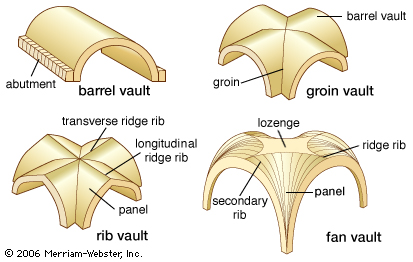
Photo found here
Might as well get on with it and talk about the most well known Roman structure: the Colosseum. With walls 144 feet tall with the capacity to hold 50,000 people who purchased tickets to specific sections, it's an ancient sports stadium. It even included a tarp to pull over the top during rain. From mock naval battles, to gladiatorial fights, to bloodshed from numerous forms of execution, this was reality TV in HD. Too bad the marble and plaster decorations as well as some of the building was pilfered for other projects.

Photo found here
What some people may not know about the Colosseum is that it was actually one of the first arenas where gladiators were actually killed. Gladiators were highly cared for celebrities. If they were injured, they would be treated with the best medical procedures of the time. And, you didn't want your gladiator killing another. If he did, you, as the manager of the gladiator, would have to pay the manager of the dead gladiator for the loos of the fighter. The arenas where not places of peace, however. Arena comes from the Spanish word for sand because that's what lined the floor. Easy way to soak up blood. However, the excessive need for the sand did not come heavily into play like it did with the Colosseum. After that, people wanted bloodshed rather than battle.
On a higher note, they worshiped gods. By that I mean all the gods. The Pantheon, with 20 feet thick walls to support the 144 feet tall dome which spans 144 feet in diameter, is the coexist movement of today. Why should we be limited to one god? What if another one gets angry? Oh, we just can't offend anyone! I know, lets not choose! Let's worship ALL THE GODS! Well, look where the Roman empire is today. Some gods. While the empire may no longer remain, the buildings still stand. Otherwise we wouldn't know about the coffered ceilings and the 30 feet wide oculus, or opening, in the ceiling.
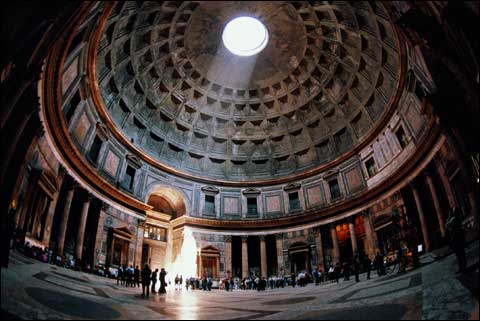
Photo from here
Time for the fun stuff. Baths! Yes, the wonderful innovation of baths! while it may not seem like much to us, it was impressive to the time period. With three different types of baths, the coldarium, the tepidarium, and the frigidarium, a lot of thought, time, and water went into them. The water had to be brought from water sources in the mountains and hills and carried miles to the city. This was possible due to the aqueducts. This was an impressive bit of engineering because it ran only on gravity with a half inch grade over a one mile span. Rome had 77 aqueducts bringing in 350 million gallons of water per day. Such a little thing seems a lot more impressive when you add a few zeros to the end of it.
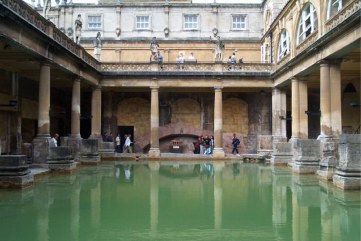
Photo found here

Photo found here
Next up is the Forum Romanum. This was the marketplace, meeting hall, town square, and religious and political center of Rome. Not much else to say on it.
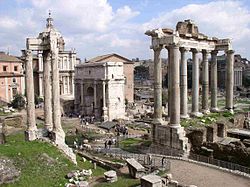
Photo found here
And here comes Constantine the Great. He would have been 30 feet tall sitting down if he hadn't lost his head. Interestingly enough, that's all we have left of him. No, I'm not talking about the actual man nitwit. I'm talking about his statue. What's interesting as well as very creepy about this statue is that its eyes are highly exaggerated to try and display visually the soul of Constantine. Also, it was because the proportions look terrible if they aren't exaggerated.
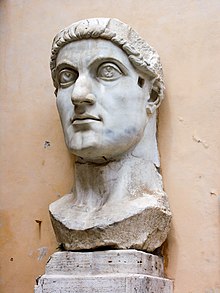
Photo from here
Lets move on to the Column of Trajan. Winding around the outside of the column is a timeline of Emperor Trajan's conquest and victories. On the inside of the column, however, lies only one thing. Trajan's ashes. Fun stuff.

Photo from here
How about we talk about another thing a lot of people now? Pompey. Well, Pompey was a place and isn't now. That's what you get for building a city at the base of a volcano. But, while unfortunate for them, it is good for us. We get to see preserved art, painting, and people from the time as the ash covered everything. Although, a lot of Pompey art is erotic scenes so I'm not certain that it was a good thing to recover it.

Photo from here
Finally, the mosaics of the time were crazy. Some of the smaller stones could have 150 tiles withing on square centimeter. Who has the time for that?

Photo from here
Well, I think we can conclude that the Romans had too much time on their hands and were a little OCD. The Romans are that kid in class that make the rest of the students look bad. Thanks a lot Rome.

I like your ending comment! ahah!
ReplyDeleteUntil there is that other kid in class that thinks he's even smarter then the previous smart kid and suggests that he is but really just embelashes everything, attracting an even bigger following (AKA Victorian Era). Yes... I just went there.
ReplyDeleteI just know that Arena comes from the Spanish word for sand because that's what lined the floor! Your blog have a lot of information hahaha :)
ReplyDelete